
Your Online Safety - current Modus Operandi
Helping keep you safe.
Staying informed is one of the best ways to protect yourself online.
Scammers and fraudsters are always finding new ways to trick people, but knowing what to look for makes all the difference.
We update this article regularly so you have the latest information on current threats and how to stay safe!
Stay One Step Ahead - Your Cyber Safety Tips
The internet has opened up a world of opportunity—keeping in touch with family, managing finances, learning new things, and enjoying entertainment.
But alongside these benefits, scams have become more common and more convincing. Many are now designed specifically to target older adults, using trust, urgency, and confusion to catch people off guard.
The good news: once you understand how these scams work, they become much easier to spot.
How Scammers Think
The Pattern Behind Every Fraud
- Urgency. They create a situation that feels like it must be handled right now — in the next hour, before the end of the day, before it is too late. This is designed to stop you from thinking clearly or consulting anyone else.
- Fear or emotion. They target your deepest worries — a loved one in danger, a threat of arrest, the loss of financial security, or the thrill of unexpected good fortune.
- Authority. They pretend to be from a government agency, a major company, a bank, or a trusted institution. The name alone is meant to switch off your scepticism.
- Secrecy. They tell you not to mention it to anyone — not your children, not your bank. They know that the moment you talk to someone else, the spell breaks.
- Untraceable payment. They ask for gift cards, wire transfers, cryptocurrency, or cash. These cannot be reversed or recovered the way a credit card payment can.

The single most powerful thing you can do when a situation feels urgent, frightening, or too good to be true: stop, say “I need to call you back.” Then hang up, wait, and talk to someone you trust. Nothing legitimate is ever so urgent that it cannot wait an hour.
Scam 1:
AI Voice Cloning — “Family Emergency” Scams
What Happens
This is one of the fastest-growing scams in 2026, and it is genuinely frightening in how convincing it can be. Scammers collect a few seconds of audio — a voice clip from a Facebook video, a YouTube comment, even a voicemail — and feed it into artificial intelligence software that clones the voice almost perfectly.
They then call you pretending to be your son, daughter, or grandchild. The “family member” is crying, saying they have been in a car accident, arrested, or are in the hospital, and they need money urgently, often $5,000 to $15,000 sent by wire transfer or courier. They will beg you not to call anyone else, claiming there is no time or that they are embarrassed.
FBI data shows losses from this type of fraud have already reached billions of dollars in 2026, and the average victim in the USA loses around $12,500.

How to Spot It
- An unexpected call with extreme urgency, maybe a accident, arrest, hospital.
- They begs you to keep it secret and not contact other family members.
- Payment is requested in cash, wire transfer, gift cards, or courier.
- Something feels slightly “off” about the voice, even if it sounds familiar.
How to Protect Yourself
- Hang up and call that family member directly on their known number.
- Agree on a family “safe word” that only real relatives would know
- Never send money based on a phone call alone, no matter how convincing the voice sounds.
- Contact another family member or friend to help verify before doing anything.
- Remember: scammers specifically harvest voice clips from social media…consider setting your profiles to private
Scam 2:
Tech Support or “Virus Alert” Scams
What Happens
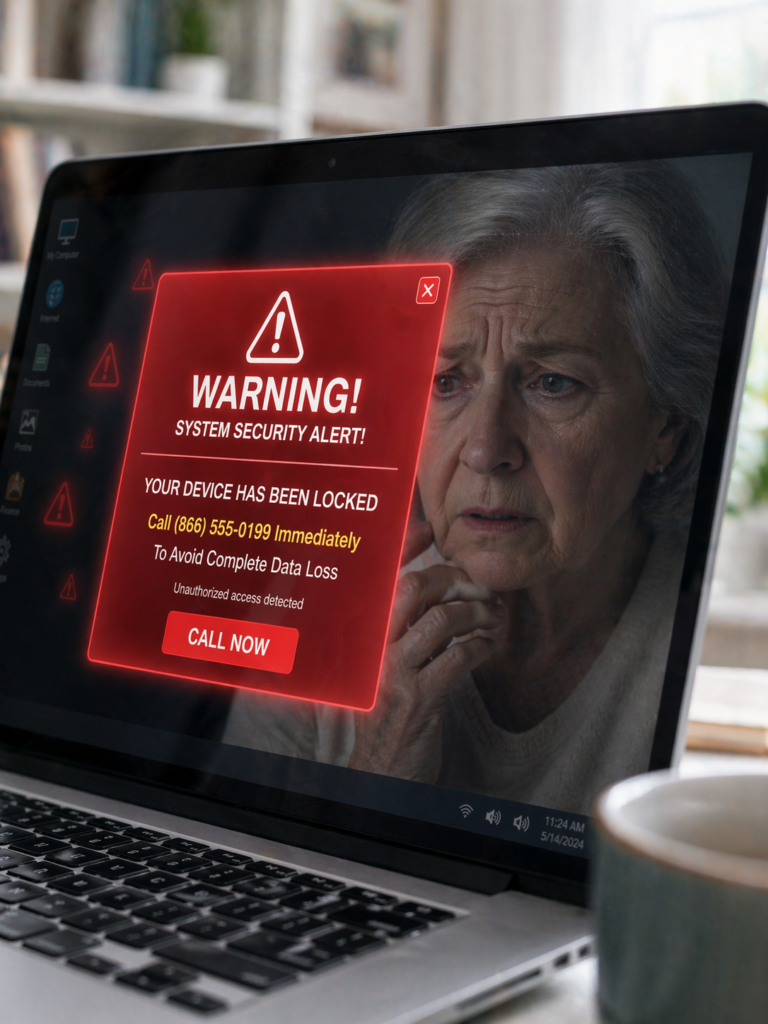
You are browsing the internet and suddenly a large pop-up fills your screen. It says your computer has a dangerous virus. There is a phone number to call. The voice on the other end sounds professional and helpful. They walk you through giving them remote access to your computer so they can “fix the problem.” Of course, there is no virus. But now they have access to your files, your saved passwords, and possibly your banking details. Victims have lost hundreds of thousands of dollars through this method.
The FBI’s 2025 Internet Crime Report listed tech support scams as one of the costliest categories, with total losses of over $2 billion.
How to Spot It
- A sudden pop-up or loud alarm sound claiming your computer is infected.
- A phone number to call for “Microsoft”, “Apple”, or “Windows Support”
- A request to install software so they can access your computer remotely.
- Pressure to pay using gift cards, wire transfer, or cryptocurrency.
How to Protect Yourself
- Close the browser tab or restart your computer. A real virus warning does not come through a pop-up with a phone number.
- Microsoft, Apple, and antivirus companies do not call you unsolicited.
- Never give anyone remote access to your computer unless you initiated the call yourself.
- If unsure, take your computer to a local trusted repair shop for a second opinion.
- Install a reputable ad blocker, which reduces the chance of seeing these fake pop-ups.
Scam 3:
Government or Bank Impersonation Scams
What Happens
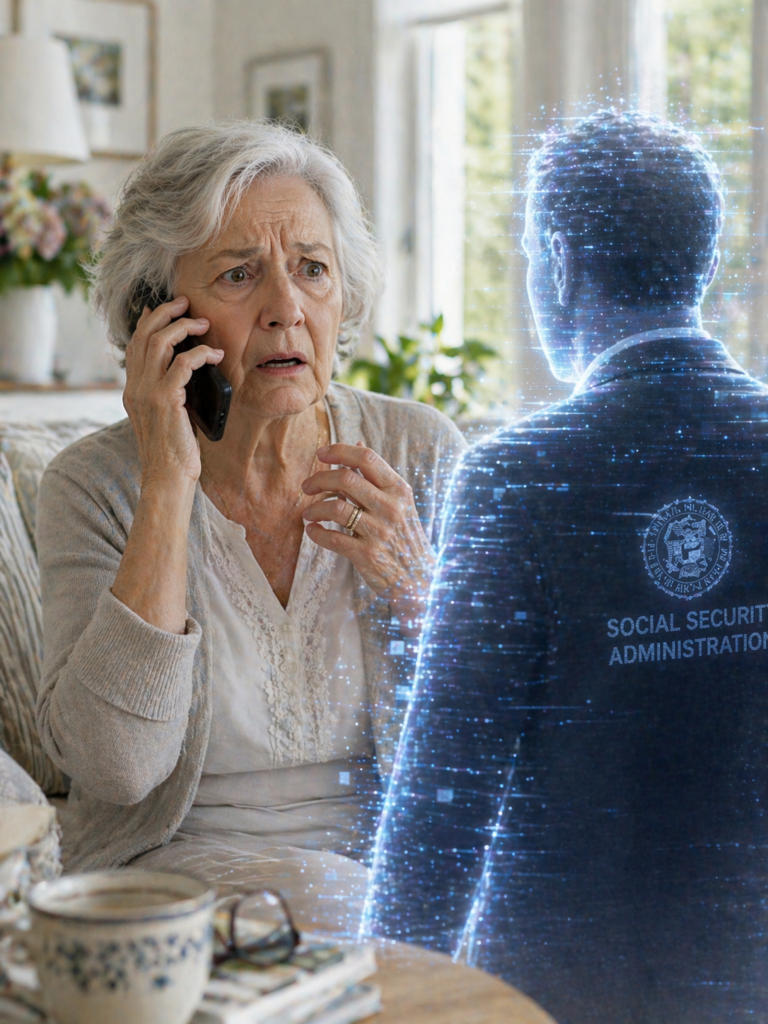
The caller introduces themselves as a Social Security Administration agent, IRS officer, or Medicare representative. They say there is a problem with your account — maybe your Social Security number has been used in a crime, or you owe back taxes, or your Medicare card needs to be re-verified. They may threaten arrest, fines, or suspension of your benefits if you do not act immediately. The goal is to frighten you into handing over your personal information or making a payment.
In 2025, the FBI received approximately 32,000 complaints about government impersonation fraud, with losses totaling $798 million.
How to Spot It
- A call from someone claiming to be from the IRS, SSA, Medicare, or law enforcement.
- Threats of arrest, benefit suspension, or fines if you don’t act immediately.
- Requests for your Social Security number, bank details, or Medicare number.
- Requests to pay a “fine” using gift cards, wire transfer, or cryptocurrency.
How to Protect Yourself
- Hang up immediately. Government agencies do not call to demand payment or personal information over the phone.
- If you are concerned the call might be real, hang up and call the agency directly using the number on their official government website.
- The IRS contacts taxpayers by mail first, never by unsolicited phone call.
- Medicare will never call to ask you to verify your Medicare number
- Report suspected government impersonation calls to the FTC at reportfraud.ftc.gov
Scam 4:
Investment and Cryptocurrency Scams
What Happens
This scam often begins with a friendly message on social media, WhatsApp, or a dating app. The person — who may be an AI-powered chatbot — builds a relationship over days or weeks before mentioning an amazing investment opportunity.
They show you screenshots of impressive returns. They may guide you to a convincing website or app where you can watch your “investment” grow. When you try to withdraw your money, you are told you must pay a tax or fee first. That fee disappears too.
In 2025, this was the single most costly scam category tracked by the FBI. Older adults with retirement savings are the primary target.

How to Spot It
- An unsolicited message from a stranger who quickly becomes warm and friendly.
- A “once-in-a-lifetime” investment opportunity with guaranteed or unusually high returns.
- Pressure to invest more money before you can withdraw.
- A request to pay fees or taxes before receiving your funds.
- Any investment involving cryptocurrency explained to you by someone you met online.
How to Protect Yourself
- Never invest money based on advice from someone you have only met online.
- Check any investment platform against the SEC’s official investor.gov database.
- If a stranger online pivots the conversation toward investments, that is a scam — full stop!
- Be especially cautious in WhatsApp groups, Telegram channels, and Facebook groups promoting investment returns.
- Discuss any investment opportunity with a licensed financial advisor or a trusted family member before committing a single dollar.
Scam 5:
Romance and Friendship Scams
What Happens
Romance scammers create detailed fake profiles on dating sites, Facebook, and other social platforms. They are patient, building a warm, attentive relationship over weeks or months.
They never meet in person (there always an excuse — they are overseas, in the military, working on an oil rig). Eventually, there is a crisis: a medical emergency, a business deal gone wrong, a plane ticket to finally come and meet you.
They ask for money, usually by wire transfer or gift card. Once you send it, the requests continue until you stop or run out of money.
AI agents can run multiple fake “relationships” simultaneously.
Losses from romance and trust scams in 2025 reached $929 million in reported cases, and unfortunately the majority of cases go unreported due to embarrassment.

How to Spot It
- They profess strong feelings very quickly unusually intense for someone you have never actually met.
- They always have a reason why they cannot video call or meet in person.
- Their profile photos look like stock images or appear in reverse Google image search as belonging to someone else
- They eventually ask for money for emergencies, travel, or business
How to Protect Yourself
- Do a reverse image search on any profile photo (right-click the image in Google Chrome and select “Search image”).
- Never send money to someone you have not met in person, regardless of how long you have been talking.
- If someone avoids video calls, that is a serious red flag
- Tell a trusted friend or family member about anyone you are getting close to online. An outside perspective is always valuable.
- Report romance scam profiles to the platform (Facebook, Whatsapp, etc.. whichever platform you are using) and to the FTC
Scam 6:
Phishing Emails, Texts, and Fake Websites — Links That Steal Your Information
What Happens
You receive an email that looks exactly like it is from your bank, Amazon, PayPal, or the postal service. It says there is a problem with your account or a package could not be delivered, or unusual activity has been detected. The email asks you to click a link and log in to fix the issue.
The website looks real. But it is a fake, designed to capture your username and password — and sometimes your credit card or bank details.
As of 2026, over 82% of phishing emails are partially AI-generated, meaning the old clues, poor spelling, awkward grammar, are no longer reliable warning signs. These emails now look professional and very convincing.

How to Spot It
- Unexpected emails or texts saying there is a problem with your account or a delivery.
- A sender email address that does not quite match the real company (e.g., support@amazon-help.net instead of @amazon.com)
- A sense of urgency: “act within 24 hours or your account will be closed”
- A link that, when you hover over it, shows a web address that looks different from the company’s real site.
How to Protect Yourself
- Contact the company directly.
- Never click links in emails or texts. Instead, open a new browser tab and type the company’s web address directly or from your own saved bookmark.
- Check the sender’s email address carefully, look for slight misspellings or odd domains.
Scam 7:
Sweepstakes and Lottery Scams — You Have Won a Prize You Never Entered
What Happens
The call, letter, or email is exciting: you have won a large cash prize, a car, or a holiday. Sometimes they impersonate well-known organizations like Publishers Clearing House to seem legitimate.
The catch: to collect your winnings, you must first pay a processing fee, tax, or handling charge, which could be a few hundred to a few thousand dollars. Once you pay, they either disappear or claim another fee is required. The prize never arrives.
Seniors are disproportionately targeted because many grew up with legitimate sweepstakes offers by mail, making the format feel familiar and credible.

How to Spot It
- You are told you have won a competition or lottery you don’t remember entering.
- You must pay a fee, tax, or charge before receiving your winnings.
- Payment is requested by gift card, wire transfer, or money order.
- The caller creates urgency ..you must claim your prize today or lose it.
How to Protect Yourself
- Remember: legitimate sweepstakes and lotteries never require you to pay money to receive a prize.
- If you did not enter a competition, you cannot have won it.
- Never send gift cards to claim a prize — this is a universally recognised sign of a scam.
- If the offer seems to be from a real company like Publishers Clearing House, look up their official number and call them directly.
- Hang up, delete the email, or set the letter aside and discuss it with someone you trust before taking any action.
Final Thought: Stay Safe and Enjoy the Online World, You Belong Online!

The internet is not a place to be afraid of. It is a place where you can video-call a grandchild on the other side of the world, take a virtual tour of the Louvre, learn to paint watercolours from a teacher in Edinburgh, or read reviews for the best restaurant in whatever town you are visiting next month. The experiences, the knowledge, and the entertainment available to anyone with a device and a connection are genuinely extraordinary.
The key is simply to go in informed. Scams are not a sign that the internet is broken, they are a sign that some people will always try to exploit what is new and unfamiliar. But familiarity is a defense, and you now have it.
Bookmark this article. Share it with a friend. Talk about it over coffee. The more people in your circle who know what these scams look like, the less effective they become.
And remember the golden rule: nothing is ever so urgent that you cannot say “I will get back to you” and take an hour to think it over. A real bank, a real family member, a real government agency — none of them will object to that. Only a scammer will push back. That pressure itself is your signal.
Stay curious. Stay connected. Just pause before you act — and when in doubt, pick up the phone and call someone you trust.
Useful Contacts If You Think You Have Been Scammed
Report scams to the Federal Trade Commission (FTC) reportfraud.ftc.gov
→ https://reportfraud.ftc.govReport internet crime to the FBI (IC3) ic3.gov
→ https://www.ic3.govAARP Fraud Watch Network Helpline
— 1-877-908-3360 (Mon–Fri, 8am–8pm ET, free, no membership required)
→ https://www.aarp.org/money/scams-fraud/helpline/National Elder Fraud Hotline (U.S. Dept. of Justice / Office for Victims of Crime)
— 1-833-FRAUD-11 / 1-833-372-8311 (Mon–Fri, 10am–6pm ET)
→ https://ovc.ojp.gov/program/stop-elder-fraud/providing-help-restoring-hope
Updated April 2026