
Leisure & Hobbies
Pick Up a Novel: How Fiction Keeps Our Brains Sharp and Our Hearts Less Lonely
There is something almost magical about getting lost in a good story. The hours pass, the world fades out, and somewhere along the way, we forget we are even reading. That feeling is not just pleasant. It is doing something genuinely good for the brain, and researchers have spent years scanning, measuring, and following readers to understand exactly why.
Fiction vs Nonfiction
Brain scans show that fiction and nonfiction do not activate the brain the same way.
Reading a novel with vivid scenes and complex characters lights up two separate brain regions at once. One builds the mental “movie” of the story as we read. The other is the same region we use in real life when we try to understand what another person is thinking or feeling.
Research published in Social Cognitive and Affective Neuroscience confirmed that fiction exercises this second region in particular, the part of the brain responsible for our ability to recognize that other people have their own thoughts, feelings, and desires. As a result fiction readers were less likely to rush to fixed conclusions, more open to new information and can be more comfortable sitting with ambiguity and uncertainty compared to their nonfiction reading counterparts.

Nonfiction works the language and comprehension parts of the brain, and that matters, however fiction goes a step further, regularly firing the part of the brain we use to understand other people.
The "Theory of Mind" Connection
Theory of mind sounds like a complicated phrase, but the idea is simple. It is the ability to recognize that other people have their own thoughts, feelings, and intentions that are different from our own. It is what allows us to understand why someone acts the way they do, to read a room, to sense when a friend is upset even when they say they are fine.
Participants who read fiction most often also showed the strongest theory of mind in social cognition performance testing, suggesting the real benefit of fiction reading and a heightened or increased ability to understand other people.
Research has also found that lifetime exposure to non-fiction, by contrast, has been associated with poorer theory of mind performance and greater loneliness. This does not mean non-fiction is harmful. It means the social workout that fiction provides is unique, and it has real-world application for how connected we feel to the people around us.

The Loneliness Factor
Loneliness is not just an uncomfortable feeling. It has been linked to higher risk of heart disease, stroke, dementia, and depression. For those of us in our later decades, the risk is especially real. Friends move away or pass on. Mobility narrows. Retirement removes the daily contact that work once provided.
The good news is that a 2026 study showed that a daily reading habit was linked to lower loneliness scores in older adults specifically.
When we are deep in a story, we are in the company of characters whose inner lives we know well. That sense of closeness is real enough that readers consistently report lower stress and better sleep alongside the drop in loneliness.
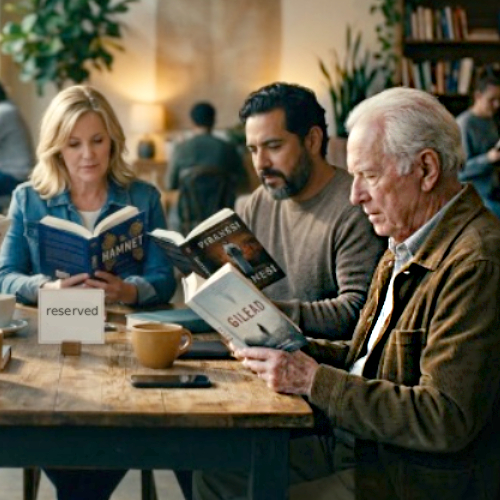
Belonging to book clubs and shared reading reduces isolation and improves mental health in older adults. A library book club is not just a pleasant afternoon out. It is, based on the evidence, a genuine health intervention.
Dementia Protection That Stacks Up
The brain benefits of reading go well beyond the social as a landmark study published in the New England Journal of Medicine found.
Among leisure activities, reading was associated with a reduced risk of dementia alongside playing board games, playing musical instruments, and dancing. Reading was specifically associated with a 35% reduced risk of dementia in that study.
Another 14-year study found that frequent reading was associated with a reduced risk of cognitive decline for older adults at all levels of education over the long term. In other words, this was not just a benefit for people who went to college or who already had sharp minds. It worked across the board.
Reading tracks characters, holds plot threads, anticipates outcomes, decodes motivation, and constructs mental images simultaneously. It is a full cognitive workout that happens to feel like pleasure.
The Final Word
Nonfiction reading is not without value. Learning, staying curious, and keeping the mind engaged all matter. A good biography, a clear-eyed health book, a well-reported history all contribute something real.
But when it comes to the specific benefits of reducing loneliness, building social cognition, and exercising the brain networks most at risk in later life, fiction has a measurable edge that research keeps confirming. Fiction improves decision-making by exposing us to diverse perspectives and scenarios. It fosters curiosity, keeps the brain actively engaged, and creates cognitive flexibility, helping us adapt to new situations more easily.
The genres with the strongest connections to social cognition gains are literary fiction and romance, stories where inner emotional and psychological life takes center stage.
Thrillers with strong character development and family sagas also provide this kind of exercise. A plot-heavy action story with thin characters provides less of the social brain workout.
That paperback on the nightstand is, as it turns out, a genuine longevity tool!
We do not need to give up nonfiction entirely, however, if we have been treating novel reading as a guilty pleasure or a lesser use of time, we now know the science says otherwise. It is one of the most effective, enjoyable, and accessible things we can do for brain health, emotional connection, and longevity, and is an important tools for those of us with mobility issues.
Thirty minutes a night. A novel from the library. A book club that meets once a month. These are not small things. They are an investment in our future health. The perfect excuse to grab that cup of tea and get comfortable with a good book!
Sources
- Tamir, D.I., Bricker, A.B., Dodell-Feder, D., & Mitchell, J.P. (2016). Reading fiction and reading minds: the role of simulation in the default network. Social Cognitive and Affective Neuroscience, 11(2), 215-224. https://academic.oup.com/scan/article/11/2/215/2375122
- Dodell-Feder, D., & Tamir, D.I. (2018). Fiction reading has a small positive impact on social cognition: A meta-analysis. Journal of Experimental Psychology: General, 147(11), 1713-1727.
- Mar, R.A., Oatley, K., Hirsh, J., dela Paz, J., & Peterson, J.B. (2006). Bookworms versus nerds: Exposure to fiction versus non-fiction, divergent associations with social ability, and the simulation of fictional social worlds. Journal of Research in Personality.
- Verghese, J., Lipton, R.B., Katz, M.J., et al. (2003). Leisure activities and the risk of dementia in the elderly. New England Journal of Medicine, 348(25), 2508-2516. https://pubmed.ncbi.nlm.nih.gov/12815136/
- Bavishi, A., Slade, M.D., & Levy, B.R. (2016). A chapter a day: Association of book reading with longevity. Social Science & Medicine, 164, 44-48. https://pubmed.ncbi.nlm.nih.gov/27471129/
- Sahakian, B.J., & Langley, C. (2025, May 19). Reading fiction boosts empathy and fights loneliness. Neuroscience News / The Conversation. https://neurosciencenews.com/reading-emapthy-loneliness-28972/
- Health Promotion International, Oxford Academic (2025). Shared reading interventions to promote psychosocial well-being in older adults: a systematic review. https://academic.oup.com/heapro/article/40/2/daaf036/8110077
- PsyPost (2026, February 23). Reading may protect older adults against loneliness better than some social activities. https://www.psypost.org/reading-may-protect-older-adults-against-loneliness-better-than-some-social-activities/
- Liu, H., et al. (2021). Reading activity prevents long-term decline in cognitive function in older people: evidence from a 14-year longitudinal study. Frontiers in Psychiatry. https://pmc.ncbi.nlm.nih.gov/articles/PMC8482376/