
Active Living
The Best Dance Class You Haven’t Taken Yet
Two Left Feet, One Big Health Payoff: Why Dancing May Be the Best Prescription for Aging Well
Three Things To Know
- Dancing regularly is linked to a significantly lower risk of dementia more so than most other leisure activities studied.
- Learning new dance styles, not just repeating the same routine, is what keeps the brain actively growing.
- Dance class delivers more than steps and music. The social connection that comes with it has measurable health value.
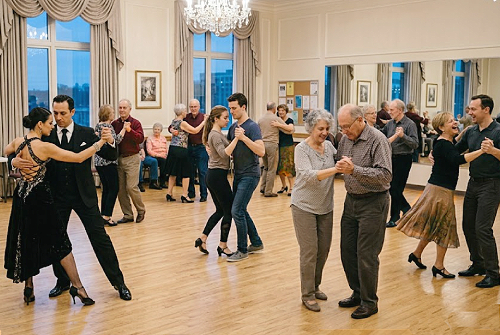
For many of us over 60, the word “exercise” conjures images of a gym we never quite get around to visiting. But dancing, at a local studio, a community center, even a church hall on a Tuesday night is something else entirely.
It turns out it may also be one of the best things we can do for the rest of our lives.
The research on this has moved well beyond the feel-good stage. Scientists who study aging are paying serious attention to dance, and what they are finding is remarkable. It hits the brain, the heart, our muscles, and our mental health all at once. And it brings something into our live that is equally important.. new friends and social connections.
What Dancing Does to the Brain
Let’s start with the big one. Many of us quietly worry about our memory as we age. We forget names, misplace keys, and wonder if it’s something to take seriously. The good news is that we have more control over this than we might think.
A landmark study published in the New England Journal of Medicine tracked nearly 500 people over 21 years and found that dancing was associated with a 76 percent reduction in dementia risk, which was the single largest risk reduction of any activity they measured, physical or mental. That number has held up across decades of follow-on research.
Why does dance protect the brain so well?
Because it asks a lot of it. To dance, we have to hear the music and respond to its rhythm, remember a sequence of steps, watch our partner or the instructor, and keep our balance all at the same time. That is not one task; it is four or five running simultaneously. Scientists call the brain’s ability to build new connections in response to this kind of challenge neuroplasticity, and dance is one of the most reliable ways to trigger it.
A 2024 review from the University of Sydney confirmed that dance outperforms many other forms of physical activity specifically on psychological and cognitive outcomes. It is not just that we are moving our bodies. It is that our minds are working hard the whole time we are doing it.
The Secret Ingredient: Learning Something New
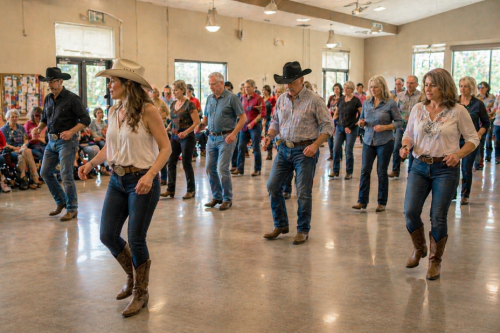
Here’s the thing… If we do the same eight-count line dance every week for five years without ever varying it, the brain eventually stops working hard. It knows the pattern. It goes through the motions.
The real protection comes from novelty, from tackling a new style, a more complex combination, or a step we have never tried before. Research shows that learning new movement sequences specifically protects the hippocampus, the part of the brain most responsible for memory, and the part most affected by Alzheimer’s. The hippocampus naturally shrinks a little each year as we age. Dance, particularly when it keeps presenting us with something new to learn, can slow or even partially reverse that process.
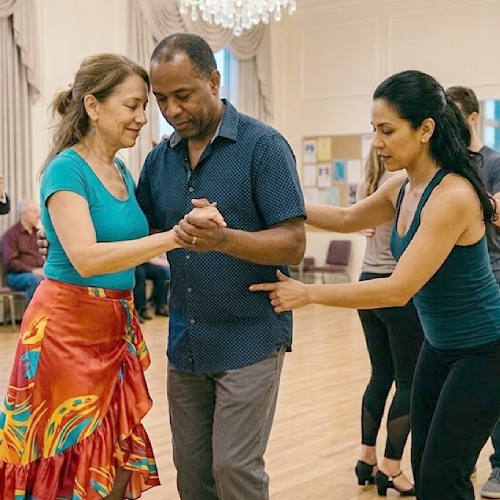
This means that slightly intimidating beginner’s salsa class, the swing dancing workshop we almost skipped, the Argentine tango lesson with the “easy on the eyes” Latin instructor that seemed too complicated are exactly the experiences our brains need. The stumbling and learning is part of the point.
“From around age 60 onward, the hippocampus tends to lose a small amount of volume each year in most people, and physical activity is one of the factors shown to slow it.”
A Full-Body Workout That Doesn’t Feel Like One
Beyond the brain, dancing delivers real physical benefits that matter more and more as we get older.
Research has consistently found that regular dancing improves muscular strength and endurance — and it does it in a way that never feels like a training session. We are too busy counting beats and watching our feet to notice we are working hard.
For older adults already dealing with early memory concerns, the physical and cognitive gains tend to arrive together. The same movement that strengthens the legs and improves balance also appears to sharpen the mind. Two problems, one dance class.
Dancing is solid aerobic exercise. Moving continuously to music for 45 minutes gets the heart rate into a beneficial zone without us even realizing it. The World Health Organization recommends 150 minutes of moderate aerobic activity per week for older adults. Two or three dance classes a week takes care of that entirely.
Then there is the balance question, and it is not a small one. Falls are among the leading causes of serious injury and lost independence for people over 65. Dancing directly addresses this by strengthening the stabilizing muscles around the hips, knees, and ankles, while also sharpening the body’s internal sense of where it is in space.
People who dance regularly tend to move with better balance and a steadier gait than those who don’t, and that difference becomes more valuable with every passing year.
The Part Nobody Talks About Enough: Other People
Social isolation and loneliness are now recognized by health authorities as genuine threats to physical health.
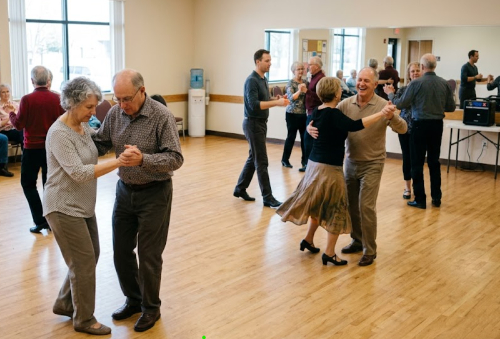
Dance is one of the most effective antidotes we have found. A 2024 community engagement study looked specifically at partner dance sessions at senior centers and found that regular participants reported meaningful reductions in loneliness and a genuine sense of camaraderie and belonging. Dance consistently functions as “a key tool for fostering social interaction and reducing feelings of loneliness in old age”.
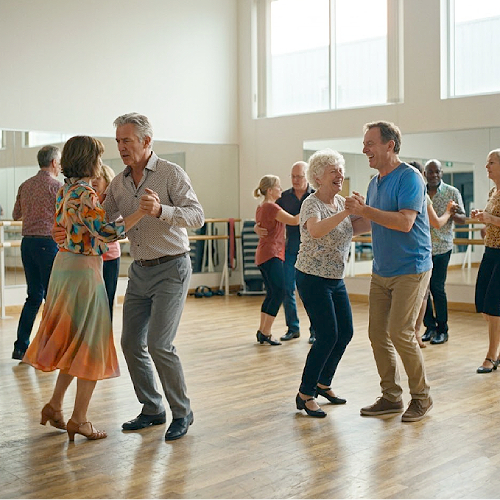
It works for a specific reason. Dance, especially partner dancing or group classes, requires us to coordinate with other people, make eye contact, take turns leading and following, and laugh together when we step on each other’s feet.
That kind of physical, synchronized social connection releases oxytocin, the bonding hormone, as well as endorphins and serotonin. These are those feel good chemicals that lift mood and reduce anxiety, and they are released in higher concentrations during social movement than during solo exercise.
Many experienced dancers will say that the twenty minutes of conversation before class and the coffee afterward matter as much as the dancing itself. It is community forming in real time.
Dance is one of the few activities that builds all of that in a single Tuesday evening.
How We Actually Start
The most common obstacle is the idea that we missed our window and that dancing is for people who started young. This is simply not true. The research includes people well into their 70s and 80s who began dancing as older adults and still showed significant cognitive and physical gains.
A few practical starting points:
Start with a structured class, not open dancing. The learning and newness is where most of the brain benefit lives. Community centers and YMCAs frequently offer beginner ballroom, line dancing, and folk dance specifically for adults.
Prioritize weight-bearing styles if bone density is a concern. Ballroom, folk, and line dancing all qualify. Chair-based dance programs exist for those with limited mobility and still deliver measurable cognitive and mood benefits.
Keep switching. Once we feel comfortable with one style, try another. The discomfort of being a beginner again is, neurologically speaking, exactly the point.
Consistency beats intensity. Two one-hour classes per week, sustained over months, produces the most consistently documented results across the literature.
There is a version of aging we have been sold that involves managed decline – slowing down, being careful, giving things up. The evidence on dance points to a different place. It points to a life where we are still learning, still moving, still laughing with people we didn’t know three months ago.
The music is already on. We have more to gain than we think. Go grab your dancing shoes!
Sources
Fong Yan A, et al. (2024). The effectiveness of dance interventions on psychological and cognitive health outcomes compared with other forms of physical activity. Sports Medicine, 54, 1179–1205.
Fonseca I, Rueda M, Cabanzo C. (2025). The effect of dance interventions on well-being dimensions in older adults: a systematic review. Frontiers in Sports and Active Living.
Hwang PW, Braun KL. (2015). The effectiveness of dance interventions to improve older adults’ health: A systematic literature review. Journal of Aging and Physical Activity, 23(3), 646–656.
Liu C, et al. (2021). Effects of dance interventions on cognition, psycho-behavioral symptoms, motor functions, and quality of life in older adults. Frontiers in Aging Neuroscience, 13.
Niemann C, Godde B, Voelcker-Rehage C. (2016). Senior dance experience, cognitive performance, and brain volume in older women. Neural Plasticity, 2016.
Nieves S. (2024). Seniors social dance for a sense of belonging: Decreasing loneliness through community connection. Lesley University.
Sánchez-Alcálá M, et al. (2025). Effects of dance-based aerobic training on frailty and cognitive function in older adults with mild cognitive impairment. Diagnostics, 15(3), 351.
Verghese J, et al. (2003). Leisure activities and the risk of dementia in the elderly. New England Journal of Medicine, 348(25), 2508–2516.
Zhang Y, Ma H. (2025). The impact of dance on the mental health of older adults: a network meta-analysis. Frontiers in Psychology.